Field Attire & Gear

Function-Driven, Mission-Focused

Victory Loves Preparedness ~ Victoria Praeparationem Amat La Victoire Aime la Préparation La Victoria Ama la Preparación A Vitória Ama a Preparação La Vittoria Ama la Preparazione Der Sieg Liebt Vorbereitung De Overwinning Houdt Van Voorbereiding Seger älskar Förberedelse Seier Elsker Forberedelse Voitto Rakastaa Valmistautumista Vítězství Miluje Připravenost

Building Readiness Through Field Attire, Equipment and Preparation

Proper field attire and equipment support safety, preparedness, interoperability, and operational readiness across the 55th Light Foot Battalion’s four core pillars: Communications, Medical Preparedness, Sustainment, and Field Operations & Response. Equipment is viewed not as an end in itself, but as a tool that supports training, skill development, and responsible participation.
Members are encouraged to acquire equipment gradually and purposefully, focusing first on foundational items such as communications, medical gear, sustainment supplies, appropriate clothing, and other practical tools that support everyday preparedness and field activities. As knowledge, proficiency, and responsibilities grow, additional capabilities may be added based on individual needs and assigned roles.
This approach emphasizes balanced capability development, ensuring that equipment, training, and experience progress together. The following Prepared Citizen Gear Acquisition Hierarchy provides a useful visual framework for understanding how readiness can be built in logical and sustainable stages.
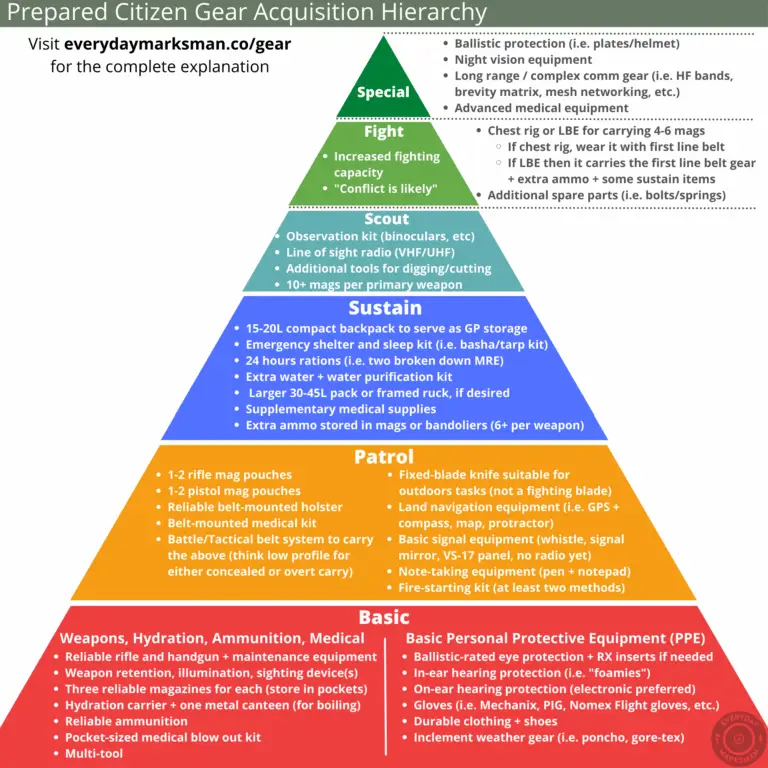
Prepared Citizen Gear Acquisition Hierarchy

The Prepared Citizen Gear Acquisition Hierarchy image is from Matt Robertson’s blog post, Do You Really Need That? A Better Gear Philosophy, published on The Everyday Marksman.
In the article, Robertson presents an alternative to traditional military-style gear acquisition models, proposing instead a staged, civilian-focused progression of capability. His framework emphasizes foundational safety, reliability, sustainment, and disciplined skill development before advancing to more specialized equipment.
This philosophy closely aligns with the principles of preparedness, readiness, and personal responsibility promoted by the 55th Light Foot Battalion.
We encourage readers to explore Robertson’s work at The Everyday Marksman, which contains a wealth of practical information and educational resources. His writing offers thoughtful guidance on equipment selection, training and development, preparedness planning, and the disciplined mindset that supports responsible civilian readiness.
Gear Acquisition Hierarchy courtesy of Matt Robertson, The Everyday Marksman.
Image Courtesy of Matt Robertson, used with Permission.

Field Attire and Uniform Standards

Field attire serves a practical purpose by supporting safety, comfort, mobility, and effective participation during training and field activities. Appropriate clothing and equipment help members operate in a variety of environments while promoting interoperability and a consistent standard of preparedness.
The 55th Light Foot Battalion utilizes a standard field uniform for training events, field exercises, and operational activities. Uniformity helps foster unit cohesion, improves identification in the field, and reinforces the professional and disciplined culture of the organization. For public events, community engagements, and official meetings, the Battalion also maintains a separate professional community uniform that presents a polished and approachable appearance while representing the organization to the public.
Individual wearing a MultiCam pattern field uniform, protective helmet, and load-bearing equipment, representing preparedness, interoperability, field attire standards, and operational readiness.
Image by Getty, Unsplash
The MultiCam pattern serves as the standard field uniform for the 55th Light Foot Battalion.
Selected for its versatility across North Idaho’s diverse terrain and environments, the uniform supports interoperability, identification, safety, and unit cohesion during training events, field exercises, and operational activities.
Combined with appropriate equipment and professional conduct, standardized field attire contributes to readiness and effective participation throughout the organization.
Detailed guidance regarding field uniforms, insignia placement, recommended clothing, equipment standards, and role-specific considerations is available within the 55th Light Foot Battalion Standards & Principles Manual.
In addition, members have access to a dedicated equipment guide designed specifically for new members. This standalone resource provides practical recommendations for prioritizing equipment purchases and capability development over time, helping individuals build preparedness in a deliberate and cost-effective manner.
Rather than serving as a mandatory checklist, the guide encourages members to focus on the Battalion’s Four Core Pillars—Communications, Medical Preparedness, Sustainment, and Field Operations—while building capability according to their experience, responsibilities, and budget.
Emphasis is placed on acquiring quality, reliable equipment, developing skills through training, maintaining legal compliance, and building readiness progressively through foundational, intermediate, and role-specific capabilities.

Equipment Resources & Vendor References

Building capability often involves researching equipment, comparing options, and identifying reputable manufacturers and retailers. To assist members and visitors in their preparedness journey, the 55th Light Foot Battalion maintains a supplemental Equipment Resources Guide containing vendor sources.
These resources are provided for informational and educational purposes only and should not be interpreted as endorsements of any particular manufacturer, retailer, or product. Individuals are encouraged to evaluate equipment based on their needs, budget, training, and intended use while focusing on quality, reliability, and practical capability rather than acquisition alone.
View the Equipment Resources Guide →